Industrial environments demand networks that are not just fast — they must be rugged, reliable, and capable of delivering both data and power. That’s why industrial Ethernet switches — especially managed PoE switches — are central to modern industrial automation, surveillance, transportation, and power systems. In this article, we’ll break down how these switches are architected, how they work under the hood, and why their design matters in real-world industrial settings.
What Makes an Industrial Ethernet Switch Different?
Industrial Ethernet switches differ significantly from typical office or data-center switches. Here’s a comparison table that highlights the main architectural and environmental distinctions:
| Feature | Typical Ethernet Switch | Industrial Ethernet Switch |
|---|---|---|
| Operating Temperature | ~ 0 °C to 50 °C | e.g. –40 °C to +85 °C (industrial PoE switches often support wide temperature) |
| Housing / Enclosure | Plastic or sheet metal | Rugged metal, DIN-rail, IP-rated (like IP40) |
| EMC / Surge Protection | Minimal protection | High protection for ESD, surge, EFT, etc. |
| Redundancy / Network Recovery | STP/RSTP used, but not always critical | ERPS (G.8032) or MSTP for ring topology and < 20ms failover |
| Power Input | Standard AC or DC options | Industrial-grade DC, dual redundant inputs |
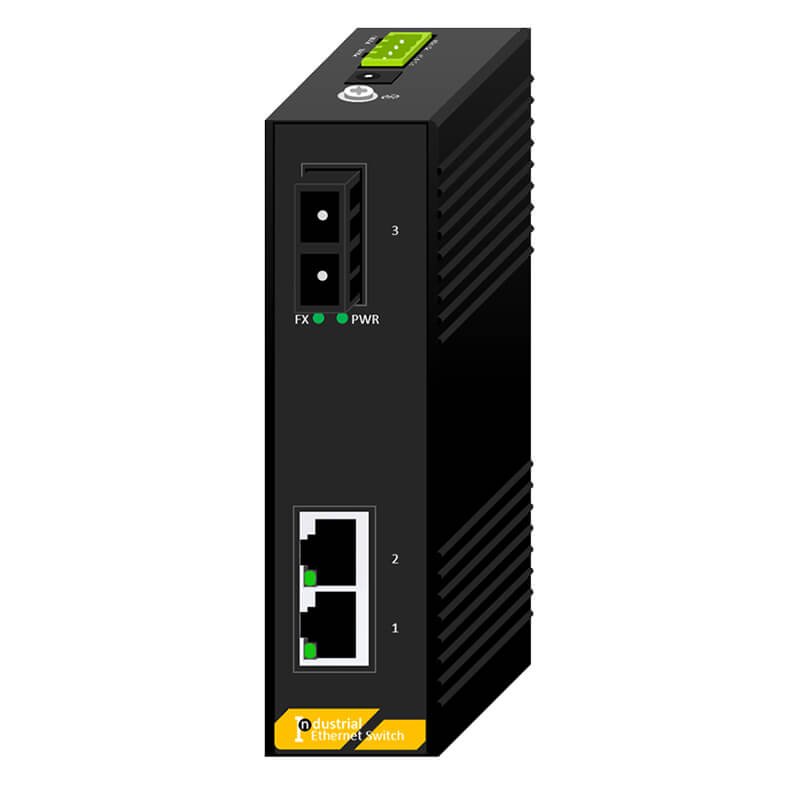
| Port Types | RJ-45, maybe SFP | Mixed: PoE RJ-45 + SFP uplink for fiber |
These differences matter—because in harsh environments, network downtime is costly or even dangerous.
Industrial-grade switches are built to survive wide temperature ranges and high electromagnetic interference, with rugged enclosures and internal protections that commercial switches often lack. Vendors like Fiberroad explicitly mention their switches support fast ring self-healing (< 20ms) via ERPS.
How Managed PoE Switches Actually Work
Data Forwarding & MAC Learning
- When a frame arrives on a port, the switch reads its source MAC address and records which port it came from.
- Over time, the MAC table (also called a forwarding table) builds up, so the switch knows where to forward frames.
- VLANs (Virtual LANs) allow segmentation: different devices can be grouped logically even if they are on the same physical switch.
- Once the switch learns where the destination MAC is, it forwards traffic on the correct port.
PoE Power Delivery
- Power over Ethernet (PoE) follows IEEE standards (e.g., 802.3af/at/bt).
- The switch detects a PoE-capable device (PD, Powered Device) and negotiates how much power it needs.
- Then it sends both data and DC power (48 V or so) over the same twisted pair, simultaneously.
- Ports often have a power budget: the switch must manage how much power is allocated per port to avoid over-committing.
Management & Control Plane
- Managed PoE switches provide multiple interfaces: Web GUI, CLI, SNMP, Telnet, etc., to configure and monitor.
- You can use VLANs, ACLs, QoS rules, and link aggregation (LACP) to optimize traffic flow or isolate critical devices.
- For redundancy, ring protocols like ERPS (G.8032) let switches form a ring topology. If one link fails, the network auto-recovers within milliseconds. ERPS is widely used in industrial switches.
- Some switches allow “one-button ring setup” via DIP switches or quick config tools (depending on model).
Why Architecture Matters in Real Industrial Networks
Industrial network architecture isn’t just a technical detail — it has real-world impact:
Surveillance and Video Systems
In a factory or city-wide security deployment, PoE switches power IP cameras and move video traffic reliably. When you combine PoE with rugged switches and ring protection, you ensure your critical video streams don’t drop, even if a cable or device fails.
Factory Automation
Machines, sensors, PLCs, and controllers connect through these switches. High-quality managed switches give you control over segmentation (VLAN), prioritization (QoS), and redundancy to keep the production line running without interruption.
Long-Distance Connectivity
Using SFP (fiber) ports, industrial switches can bridge very long distances — hundreds of meters to tens of kilometers — which is useful for remote substations, mining sites, or large plants.
High Availability with Ring Topology
Ring technologies like ERPS (G.8032) provide failover recovery in < 20ms in some industrial switch product lines. That means even in case of cable breaks or link failures, the network recovers so fast that time-sensitive applications (like control loops or video) are minimally affected.


Conclusion
Industrial Ethernet switches — especially managed PoE models — are not just “office switches that can take a beating.” Their architecture is designed from the ground up for harsh environments, power delivery, redundancy, and fine-grained management. Whether you’re building a factory automation system, a mission-critical video surveillance network, or a resilient industrial control network, understanding how these switches work gives you a huge advantage when designing for reliability, performance, and uptime.